Improving maternal vaccination awareness in remote areas of the Kilimanjaro region in Tanzania
Dr Agnes Msoka, Kilimanjaro Clinical Research Institute, Moshi, Tanzania
Maternal vaccination has proven to protect newborns from neonatal tetanus, which has a mortality rate of about 30% to 70% in developing countries. This project aimed to improve maternal vaccination services uptake in pregnant women and postnatal mothers in Tanzania.
The project was implemented in three steps: baseline assessment, training and evaluation. Participants included health care workers (HCWs), mothers and community members from 10 villages, who were selected on the basis of their interest in participating in the project and their availability. For assessing problems related to maternal vaccination experienced in the communities, in-depth interviews (IDIs) and focus group discussions (FGDs) were conducted with 58 HCWs, mothers and other community members. In the training phase, 10 HCWs were educated as “trainer of trainers” to teach community leaders, who in turn trained the communities including mothers during routine community meetings. In a third phase, FGDs and IDIs were conducted to evaluate the acquired knowledge among HCWs, mothers and other community members.
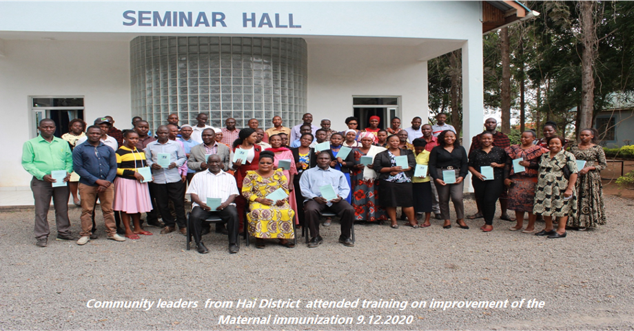
The baseline assessment revealed a shortage of human resources among HCWs, a shortage of tetanus vaccines, a lack of awareness of maternal vaccination among mothers, who were often not able to visit vaccination services due to being occupied with household responsibilities, and little interest in antenatal care among their husbands. While the baseline findings helped to enrich training content, the results from the evaluation phase helped to assess the impact of the project. The data generated in the evaluation phase suggests that the project resulted in an increased vaccine awareness in the communities and that more mothers visited clinics for antenatal examinations at an earlier stage. Also more men supported their wives in receiving vaccination services.
It can be concluded that knowledge gaps and lack of awareness were the major reasons for inadequate use of vaccination services. The availability of service providers and proper timing of vaccination service provision are additional keys for the accessibility of vaccination services. The project demonstrated that vaccine awareness creation through community meetings is a low-cost measure for a sustainable promotion of maternal vaccination services.
-
Increased knowledge and understanding of the TT vaccine in order to increase the number of pregnant women and postnatal mothers taking the Tetanus vaccine as compared to the previous numbers before the intervention.
-
Kilimanjaro region in Tanzania – Hai district
-
2020-2021
-
Health Care Workers (HCWs) and community leaders – in order to impact the behaviour of community members – pregnant women and mothers, and their husbands.
Community members attending sessions across 10 villages
-
Co-production of dramatization portraying barriers to maternal tetanus vaccination specific to each community by members and leaders and health care workers intended to educate the community and change behaviour (see example).
The trainings and knowledge sharing to foster networking and relationship building between community health workers and community members.
-
Posters and Brochures
One Training Course of Health Care Workers trained for two days (10 participants)
One Training Course of Community leaders trained for one day (48 participants)
Knowledge sharing: Community sessions attended by 1,273 community members from 10 villages.
-
New experiences: The use of drama as one of the mode of delivering education during community sessions had never been done before in all communities, it spiked attention as it was interactive, all the people in the drama were local people from the community, everyone in attendance seemed to enjoy, understand and relate to the messages delivered as compared to other modes (eg; teaching, using illustrations from the leaflets as some could not read)
All community health care workers and community leaders trained by the project reported the experience acquired as an inspiration and fuel for continuous health education in the community.
Community leaders and health care workers during the interviews in the evaluation phase reported an increased knowledge and awareness of tetanus vaccine importance, antenatal care and also there have been an increased number of people attending the antenatal clinic asking for the vaccine.
The trained community leaders and community health care workers have been working together in continuous health education using community sessions, where at least two villages reported to have conducted one community session each after the one organized by the project. It shows the project created a successful teamwork between community health workers, community leaders including the community members.
Mothers had an improved attitude towards antenatal visit and the importance of tetanus vaccine. Also most men have been accompanying their wives to the clinic and inquire more information about pregnancy and services provided at the clinics including tetanus vaccine.