“Operation thrive” – An innovative community-based initiative in tribal areas of India to improve maternal and neonatal health
Dr Nirmalya Mukherjee, Manbhum Ananda Ashram Nityananda Trust (MANT), Kolkata, India
This project was implemented to promote changes in social norms and behaviours pertaining to vaccination during pregnancy and the neonatal period among tribal communities West Bengal, India, by proactively engaging the tribal women and girls. It focused on building their capacity in using community radio, podcasts, narrowcasts and videos produced by communities to bring about the desired changes. A series of training programmes were organised to capacitate propagators.
During the project audio content for community radio, web radio, podcasts, and social media (Facebook and WhatsApp) were produced by tribal women in Purulia District in tribal languages to promote their views and experiences in maternal and child health including vaccination. Videos produced by tribal women highlighted the importance of antenatal care (ANC), vaccination before pregnancy, institutional delivery, postnatal care (PNC), immunisation of infants, services availability at the local level (the place of ANC/PNC and vaccination service, health care facilities), benefits provided by the government (transport services, supplementary nutrition, allowances) and success stories. The personal anecdotes of tribal women as part of videos prepared by them reveal the increase of knowledge of services available, importance of vaccination and safe motherhood and favourable attitude towards health care services. This led to discussions within the tribal communities of the problems and solutions thereto in the village assemblies. This further resulted in an articulation of the demand for services by informing local health authorities and by persuading them to ensure the same and supply necessary space/room for health workers to provide care and propagate the health services availability.
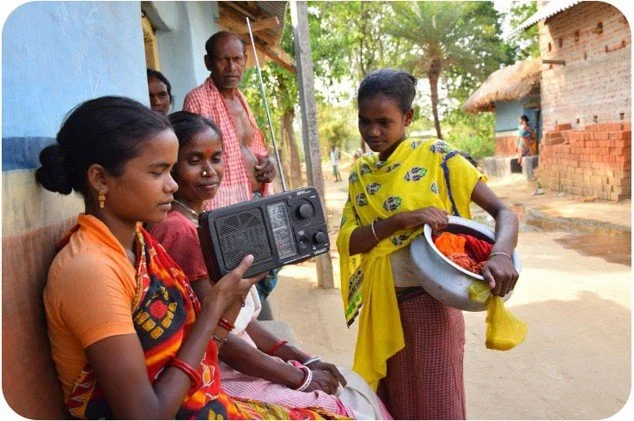
While these videos were shown in the traditional village assemblies, the community radio listening centres which had been installed in the 51 tribal villages, were the hubs of lively discussions and spaces for feedback from the community members. Furthermore, audio messages (specially prepared for the WhatsApp messenger service) and videos on ANC, institutional delivery, postnatal care, and immunisation were produced for social media campaigns. In addition, regular live phone-in programmes were broadcast on maternal and child health including the importance of immunisation.
In total, approximately 250,000 people were reached with the project. The project has come up with audio and video content on maternal and child health in the tribal language Santali. This is especially relevant as there is hardly any production of similar material to generate awareness on maternal and child health including immunisation among tribal people in their own language by governmental or state authorities.
The project was successful in raising the issues of maternal and child health and vaccination in tribal village assemblies to resolve challenges and barriers related to antenatal and postnatal care, institutional delivery, neonatal health, and early immunisation. And for that, a strong partnership has been built with the ‘Council of the Five Elders’ Aatu-Marehar, a tribal decision-making body on the village level consisting of 5 individuals whose decisions are binding to the village population. It is hoped that the fruits of this partnership will be felt for years to come as the manifold issues relating to maternal and child health have been discussed with due importance and stress at various fora.
-
Increase knowledge and promote change in social norms and behaviours pertaining to vaccination during pregnancy and the neonatal period among tribal communities in India
-
Purulia, West Bengal, India
-
2020-2021
-
Tribal communities in Purulia engaging with all members of society from informal leaders, to women, to members of government. Aim to reach very large tribal audiences through multiple different media initiatives including mass media (see example). Population of Purulia is 2.9 Million with around 20 per cent of the population Tribal. Santhali speakers.
-
Engaging community members in the development of content on maternal health and vaccination to be disseminated among their own communities in order to build the capacity of the participants as well as influence health seeking behaviour. Particular focus on women’s role. Developed materials and content in underserved languages.
Capacity building of Tribal women and girls
Use of community radio, podcasts and media production
Broadcast and Narrow-cast Radio Programmes
Involvement of Aatu Marehar means “council of the five elders,” who represent an informal head of the tribal tradition
Community Screening of Videos at Kulhi-durup Meetings (Traditional Village Assembly)
Workshops for informal leaders, service providers and local governments
Addressing “information poverty”
-
No of Radio Magazines Prepared – 220
No of Live Programmes including Facebook Live – 20
Number of Videos Prepared by Tribal women – 107
Examples of video content: a short film on nutrition in pregnancy and a play on health checkups in pregnancy
Narrowcast of audios and Community Screenings – 873 with a coverage of 21,857 people
Publications (including COVID-19) – 17 (for Social Media)- by Project Staff
Radio Programmes on Vaccine Hesitancy –11
Partnerships with Council of Five Brothers in 39 Tribal villages with more than 17,000 population.
Training courses- Radio Jockey – 3 (25 women) and Community Video – 3 (25 Women) and Community Leaders – 1 (49 village heads).
More than 250,000 people covered through radio, web-radio and social media campaigns.
Baseline and endline survey
-
Personal anecdotes of women taking pro-active decisions and receiving health care services have been documented in various radio programmes and videos
Increased knowledge on the issues and services availability helped more tribal women to go for health care service- it was also verified by the front-line health workers in videos
Tribal women who were trained in community video and radio production have become role models in the community. More women and girls have come to the radio station for programme development and broadcast on the same topics (see video statement)
An attitudinal change among husbands and other family members and community leaders and there is a social support for availing maternal health care services including immunization
The village assemblies have become forums for discussions on maternal health
Due to active engagement with communities there is no Covid vaccine hesitancy in the tribal villages where the project has been implemented